That is the uncomfortable part. Corrosion is rarely a materials failure. It is a decision failure — which coating went onto the steel, how much cover the rebar got, whether water drains away or sits.
How much does corrosion cost India?
| Scope | Annual cost | As a share of GDP |
|---|---|---|
| India, all sectors | ₹14.15 lakh crore (~$180 bn) | 4.3% of national GDP |
| Infrastructure sector | ₹1.42 lakh crore | 2.9% of sector GDP |
| Indian Railways | ₹23,800 crore | — |
| Power sector | Not disclosed in ₹ | 10.1% of sector GDP |
| Recoverable by galvanising infra steel | ₹49,580 crore | ~1.0% of sector output |
Source: Nomura Research Institute; CII Annual Infrastructure Summit, September 2026.
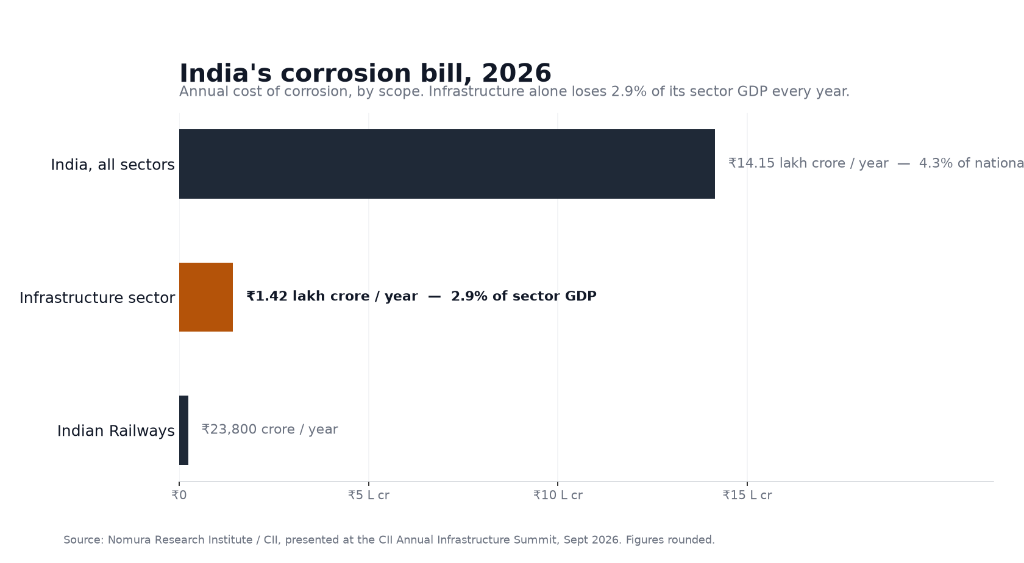
Two scopes, two numbers — worth keeping separate. The ₹14.15 lakh crore / 4.3% figure is national and covers every sector. The ₹1.42 lakh crore / 2.9% figure is infrastructure only.
A caution on secondary sources. Several trade publications have reported the infrastructure figure as "₹142 billion" — a ten-fold understatement. Cite the primary report.
Why infrastructure carries the biggest bill
Infrastructure carries the largest absolute corrosion cost of any sector studied. That is a function of two things: asset density, and exposure. A nation building roads, metros, ports, transmission lines, solar farms and industrial plants at India's current pace is putting an enormous quantity of steel into chloride-rich, monsoon-soaked, high-humidity environments — and then asking it to last 25 to 50 years.
The finding most worth repeating is this: the single highest-return intervention the research identifies is moving infrastructure steel from painted to galvanised. Estimated saving: ₹49,580 crore a year, roughly 1% of the sector's economic output.
Not a new material. Not a new construction method. A coating decision, made once, at the drawing board.
India's Corrosion Bill, 2026 — Annual Cost by Scope
Alt text: Horizontal bar chart comparing India's annual corrosion cost across sectors (Nomura Research Institute / CII Summit 2026).
Where the losses concentrate
Power — the worst-affected sector at 10.1% of sectoral GDP. Corrosion here is not only a maintenance line item; it is an energy bottleneck. As India scales renewable generation and transmission, the exposure grows with it — every new solar farm, every new tower, every new substation adds to the pool of steel standing in the weather.
Indian Railways — ₹23,800 crore a year. Rolling stock and fixed infrastructure both degrade. The knock-on effect lands on national logistics costs, because heavy maintenance pushes freight toward less efficient modes.
Telecom. Indian standards already require zinc coating for primary structural members. The recommendation is to extend corrosion protection to auxiliary components and adopt periodic inspection regimes. Towers are the classic case of a cheap component deciding an expensive asset's life.
Roads, bridges, buildings and automotive. No standalone rupee figure is published; these sit inside the national ₹14.15 lakh crore. The pattern is consistent — as assets age, maintenance costs climb, service lives shorten, and replacements arrive earlier than planned.
The real cause: buying a 25-year asset on a first-year budget
Indian public procurement overwhelmingly buys on lowest upfront cost. That is a rational rule applied at an irrational boundary — the boundary is the construction contract, not the asset's life.
The research recommendation is direct: adopt lifecycle cost analysis (LCCA) for infrastructure projects instead of focusing primarily on upfront construction cost.
The calculation that changes the conversation is short. Run it with your own numbers:
| Line | Painted steel | Galvanised steel |
|---|---|---|
| 1. Supply and install, day one | Lower initial Capex | Slight upfront premium |
| 2. First recoat required (year) | Year 7 – 10 | Year 25+ (Maintenance-free) |
| 3. Recoats over design life | 2 to 3 major cycles | 0 cycles |
| 4. Coating maintenance, nominal | High recurring expense | Zero to minimal |
| 5. Line 4 discounted to today (NPV at your cost of capital) | High NPV burden | Negligible NPV |
| Total lifecycle cost | 2.5x - 4x Upfront Cost | Lowest Total Asset Cost |
A structure specified for a 25-year life but coated for a 10-year one does not fail at year 25. It fails at year 10, and again at year 18, and each intervention costs more than the last because access, scaffolding and shutdown are now part of the bill.
What changed in 2026
The regulatory ground moved this year and most project teams have not caught up.
- NBC 2016 has been withdrawn. The National Building Code of India 2016 was superseded by the National Building Construction Standards 2026 (NBCS 2026), published as SP 7:2026, notified 30 April 2026 — with no transition period.
- It is advisory, not mandatory. NBCS 2026 is a set of voluntary guidelines; adoption depends on state governments and local bodies, which have been given greater autonomy on space, height and administrative compliance. The fire and life-safety threshold for residential buildings moved from 15 m to 24 m.
- BIS standards are being aligned with global practice, with a stated direction of exposure-based durability requirements, service-life frameworks for steel, modern testing methods and stricter inspection and enforcement.
- Durability is becoming a document. The consumer affairs ministry has proposed a three-month "best-before" for specialised cement used in dams and bridges, and the Centre has floated a durability certificate for buildings.
Read together, the direction is unambiguous: durability is moving from a judgement call to a specified, documented and inspected requirement. Projects designed in 2026 will be judged on it.
Six decisions that pay back
1. Specify the coating, not just the steel grade. "MS structure" is not a specification. Coating system, dry film thickness, surface preparation grade and standard reference are.
2. Move up the coating ladder where chlorides are high. Zinc-aluminium-magnesium coatings outperform conventional zinc in coastal and high-humidity exposure. On a 25-year asset, the premium is small against the maintenance it removes.
3. Protect the rebar, not only the concrete. Fusion-bonded epoxy (IS 13620) and cement-polymer composite coatings exist precisely because concrete cover alone is not enough in aggressive environments.
4. Design water out. Detailing decides durability more often than material choice does: drainage falls, no water traps, steel clear of grade, correct cover for the exposure class under IS 456.
5. Isolate dissimilar metals. Bimetallic contact is where corrosion starts. Insulate and specify the joint, don't leave it to site.
6. Inspect on a schedule, not on failure. The research recommends periodic inspection regimes. A condition survey at defined intervals costs a fraction of an emergency replacement — and it converts maintenance from reactive to planned.
Coastal India is the hard case
Chennai, Tuticorin, Kochi, coastal Gujarat — these are chloride environments. Salt-laden air and monsoon cycles attack steel far faster than inland exposure, and the design response is different: higher coating mass, better detailing, more conservative cover, earlier inspection intervals.
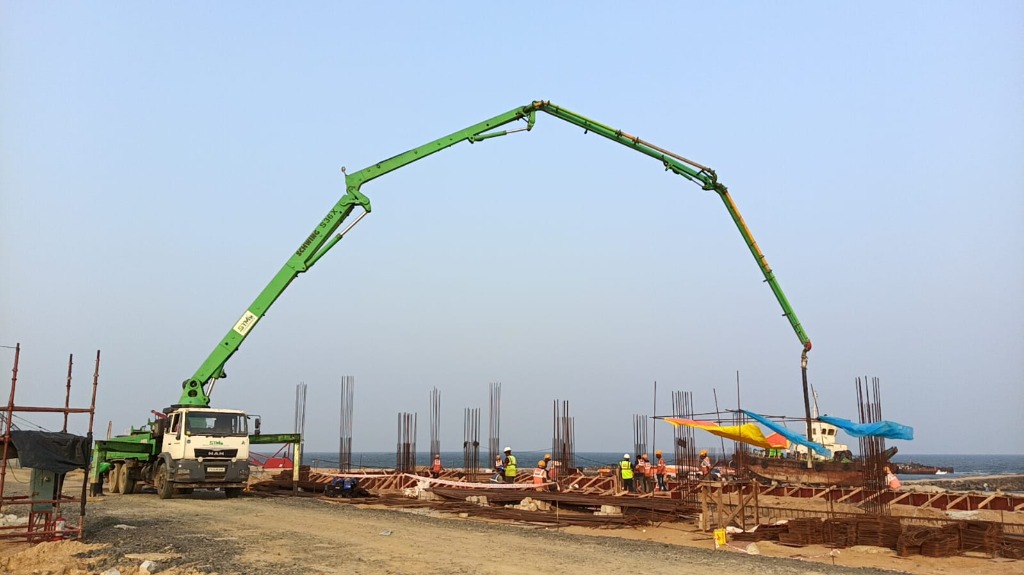
AARAA's coastal portfolio includes civil works for the 400 MLD SWRO desalination project at Perur, Chennai, delivered for VA Tech Wabag under CMWSSB. A desalination plant is about as aggressive a corrosion environment as Indian construction produces. Durability there is not a value-add; it is the engineering problem.
Where this bites hardest for Indian asset owners
Solar. A solar asset is underwritten on a 25-year life against a 25-year PPA. The mounting structures, inverter and transformer foundations and cable trays are the parts most exposed to weather — and the easiest to under-specify at tender stage, because they are a small share of capex and a large share of future risk. When the structure's service life is shorter than the tariff period, the return on the whole asset is impaired. Learn more about our specialized solar EPC contractor in Chennai solutions.
Pre-engineered buildings. In a PEB, the steel is the building. The coating specification is the entire durability story — there is no brick, no plaster and no cladding forgiving a weak decision underneath. Explore our turnkey industrial construction services.
Industrial and process facilities. Chemical plants, coastal plants, foundries and alloy units combine aggressive internal atmospheres with aggressive external ones. Corrosion here shows up as unplanned downtime, not as a maintenance bill. See our work on the industrial work shed, Gummidipoondi for Meganath Alloys, or our regional industrial construction, Kochi expertise.
How AARAA approaches durability
AARAA Infrastructure has been building since 2012, with 100+ projects delivered across 20+ cities and a self-performance model — the same teams who plan the work execute it, which is what makes a specification stick all the way to site.
Our quality management is ISO-certified, and we work to BIS, NBC and the relevant IS codes across every project category. In practice that means coating and durability requirements are written into the specification, verified at procurement and inspected on site — not left as an assumption.
Representative work:
- 180 MWp Solar Power Project, Tuticorin — civil infrastructure for Waaree Energies: site grading, earthworks, MMS foundations, internal roads and drainage (₹11 crore)
- 132 MW Wind-Solar Hybrid, Kudligi, Karnataka — civil infrastructure for Continuum Green Energy: piling, trenching, internal roads, drainage and foundations (₹20 crore)
- 140.6 MW Wind-Solar Hybrid, Hulikunte, Karnataka — solar foundations, electrical equipment foundations, inverter infrastructure and structural works
- 400 MLD SWRO Desalination Plant, Perur, Chennai — civil works package (₹5.19 crore)
- Industrial work shed, Gummidipoondi — 35,000 sq ft heavy-duty industrial shed for Meganath Alloys
We also provide integrated solutions like MEP and HVAC services, as well as turnkey projects as leading EPC contractors in Chennai, renewable energy EPC, Mumbai, and renewable energy EPC, Hyderabad.
Frequently asked questions
How much does corrosion cost India every year?
India loses an estimated ₹14.15 lakh crore (~$180 billion) to corrosion annually — about 4.3% of GDP, according to Nomura Research Institute. The infrastructure sector alone accounts for ₹1.42 lakh crore, or 2.9% of its sector GDP.
Which sector loses the most to corrosion in India?
The power sector is the worst affected relative to its size, at 10.1% of sectoral GDP. In absolute terms, infrastructure carries the largest bill at ₹1.42 lakh crore a year. Indian Railways loses ₹23,800 crore annually.
Is galvanised steel worth the extra cost?
On a lifecycle basis, usually yes. The research estimates that switching infrastructure steel from painted to galvanised could save ₹49,580 crore a year. Galvanising costs more upfront but typically removes multiple recoat cycles over a 25-year design life — and each avoided recoat saves access, scaffolding and shutdown costs, not just paint.
What is lifecycle cost analysis in construction?
Lifecycle cost analysis (LCCA) totals every cost an asset will incur over its service life — supply and install, maintenance, recoating, repair and replacement — discounted to present value. It replaces lowest-upfront-cost procurement with lowest-total-cost procurement, which is the change the NRI report recommends for Indian infrastructure.
Does the new NBCS 2026 change corrosion requirements?
NBCS 2026 (SP 7:2026) replaced the National Building Code 2016 on 30 April 2026. It is advisory rather than mandatory, and gives states greater autonomy. Separately, BIS standards are being aligned with global practice around exposure-based durability requirements and service-life frameworks for steel — so the direction of travel is toward stricter, documented durability specification.
How do you protect steel structures in coastal areas like Chennai?
Use a higher-performance coating system — galvanising or zinc-aluminium-magnesium rather than paint alone — with a specified dry film thickness. Detail for drainage so water cannot pond on or against steel, keep members clear of grade, specify protective coatings on rebar, isolate dissimilar metals at connections, and inspect on a fixed schedule rather than after a failure.
Building on the coast? Specify durability before you specify price.
If your project sits in Chennai, Tuticorin, Kochi or anywhere near the coast, the coating and durability decisions made at design stage will still be with you in 2050.
AARAA Infrastructure delivers turnkey civil construction, pre-engineered buildings and solar EPC projects across India — with durability specified, verified and inspected, not assumed.
Corporate office: #85, 4th Floor, Lotus Tower, Anna Salai, Guindy, Chennai 600032 · +91 868 100 3111